
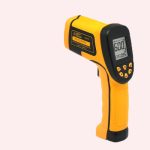


Features :
Infrared Thermometer
... people are viewing this right now
Infrared thermometers are temperature sensing devices that use electromagnetic radiation to make non-contact surface temperature readings. Infrared thermometers, sometimes called pyrometers, are widely used throughout many industries and environments. They are especially useful for applications in which quick spot temperature readings are desired or where conventional temperature sensors cannot be easily used.
Thermometers can be classified as either contact or non-contact. Contact thermometers, as the name implies, must touch the target to determine its temperature. The bulb thermometer hanging outside, for instance, measures air temperature by being in direct contact with the air. Bimetal thermometers and those that use thermocouples and RTDs are all examples of contact thermometers. Contact thermometers are inexpensive and accurate, making them the most prevalent type of thermometer in temperature measurement.
Contact thermometers, however, have limitations. They often take time to come up to temperature and making them more suitable for fixed mounting to constantly monitor temperature than for quick spot-checking of temperature. Inadequate space, distance, moving targets, or environmental conditions may also restrict their ability to contact the medium. These situations are where infrared thermometers excel.
Applications for Infrared Thermometers
Infrared thermometers are highly versatile making them indispensable tools in the technician toolbox. They can be employed anywhere at any time. Some common applications include:
- Checking mechanical equipment for hot spots that may be a sign of impending failure
- Inspecting electrical panels, circuit breakers and outlets for hot spots
- Checking heater or oven temperature, for calibration and control purposes
- Detecting hot spots / performing diagnostics in electrical circuit board manufacturing
- Checking for hot spots in firefighting situations
- Monitoring materials in process of heating and cooling, for research and development or manufacturing quality control situations
- Identifying hot/cool spots during home inspection to find drafts or to determine if insulation is adequate
- Checking temperatures as part of auto maintenance
How Infrared Thermometers Work
Infrared radiation is one of many forms of electromagnetic energy and consists of wavelengths of energy just longer than those of visible light. Infrared, like visible light, infrared can be focused, reflected or absorbed.
All matter above absolute zero constantly emits infrared energy due to the natural vibration of molecules. This vibration, and the corresponding infrared energy, is proportional to the temperature of the matter the warmer the matter, the more vibration and the more infrared energy emitted.
Infrared thermometers use a lens to focus infrared energy emitted from an object onto a detector, called a thermopile. The detector, in turn, converts that energy into an electrical signal which, after compensating for the ambient temperature, is displayed in units of temperature. Filtering and signal processing amplifies and stabilizes the signal for more accurate and linear readings.
Specifications and Features of Infrared Thermometers
As with most instruments, infrared thermometers are available in a range of styles with specifications suited to one budget and needs. Some of the most common specifications and features include:
Emissivity: Emissivity refers to the ability of a material to emit thermal radiation. All materials absorb, reflect and emit radiant energy. Certain materials, however, are better at doing this than other materials. Emissivity, therefore, is the ratio of the radiation emitted by a surface of a material to the radiation emitted by a blackbody, both a perfect absorber and emitter of energy, at the same temperature. All radiation absorbed by a blackbody will also be emitted by it. Blackbodies therefore have an emissivity of 1.0. Dark materials with a rough surface generally have a high emissivity. Asphalt for example has an emissivity of 0.90 meaning that it absorbs and emits 90 percent of radiant thermal energy and reflects only 10 percent.
The bottom end of the emissivity scale would be the perfect reflector which reflects, rather than absorbs, all radiation. The emissivity of this theoretical surface would be 0.0. Bright, glossy materials generally have a low emissivity. Aluminum foil, for example, has a thermal emissivity value of 0.03, meaning it absorbs and emits only 3 percent of radiant thermal energy while reflecting 97 percent. Obtaining an accurate measurement on low emissivity materials can be very challenging.
Although some basic models of infrared thermometers have fixed emissivity, many have adjustable emissivity settings that can be determined by the user. Emissivity tables provide standards for common materials allowing users to adjust settings for models with such capability.
Distance-to-spot ratio:The distance to spot ratio, usually abbreviated as D:S, refers to the size of the measurement area (spot) when the device is held at a certain distance from the target. For instance, a unit with a 20:1 D:S ratio will produce a diameter measuring spot when held from the target, or spot when held away. This is important since the spot is an area over which temperatures are averaged. If the actual target is very small, it is best to have a unit with a higher ratio so as not to risk inaccurate measurements by including areas not targeted in the measurement. Calculating the spot size using the D:S ratio may be misleading for close focus units or those involving long distances
Spectral range:Infrared light consists of wavelengths from 0.7 to 1000 ¼m. Spectral range refers to the specific range of wavelengths captured by an infrared thermometer. Most infrared thermometers operate under 20 ¼m. This is due to both cost efficiency as well as the negative effects on accuracy caused by the atmosphere on longer wavelengths.
Laser sight:Laser sights are often found on infrared thermometers. Their only function is to help aim the unit. The actual measurement area is larger than the red dot.
Fixed vs handheld:Most imagers are handheld, making them ideal for spot checking temperatures for maintenance, troubleshooting, or inspection. Some, however, are designed to be fix mounted as part of a process application. There are a wide range of outputs available to integrate into a control system.
Additionally, infrared thermometers can include a number of other such as communications, data logging, ingress protection, and others.
Things to consider when selecting an infrared thermometer:
- Should the unit be handheld or fixed?
- What is the target size and distance?
- What type of surface is being measured?
- What is the required temperature range?
- What is an acceptable level of accuracy?
- What is the ambient environment?
- Are data logging or communications needed?
- What are the output requirements?
Alpha Trade Bangladesh is a professional supplier of Infrared Thermometer in Bangladesh. To Know more about Infrared Thermometer in BD contact with Alpha Trade Bangladesh anytime.
Related Products
UTi384M Thermal Imager Read more
- 4” Touch display screen (480×800 Pixels)
- IR resolution: 384×288
- Temperature measurement range: -20℃ to 650℃ , external lens up to 1500℃ / -4℉ to 1202 ℉, external lens up to 2732℉
- Interchangeable lens (Optional Telephoto lens / High Temp lens)
- Manual focus
- Auto alarm for high/low temperature
- Auto tracking for hot spot/cold spot
- On display screen analyzer: 5 Points/2 Lines/5 Rectangles/5 Circles
- Image capture

Ultrasonic Open Channel Flow Meter I Drainage Flow Meter Read more
Category:Flow Meter
Tags: Type of flow instrument that is used to indicate the amount of liquid, gas, or vapor moving through a pipe or conduit by measuring linear, non-linear, mass, or volumetric flow rates.Flow meter for drainage, flow meter supplier in Bangladesh,

UT309C Professional Infrared Thermometer Read more
UT309 series professional infrared thermometer can determine surface temperature through the energy radiated by the target surface. It is designed to meet some of the highest protection ratings in UNI-product line, IP65 and 3m drop proof. With a rapid response rate of 250ms, high measurement accuracy, and multiple scanning modes, UT309 proves to be a necessary tool for engineers and technicians working in a various elds such as electrical distribution inspection, HVACR maintenance, transportation equipment inspection, instrument repair, and many more.
Features:
1. 3m drop proof, IP65
2. Large LED display with backlight
3. MAX/MIN/AVG/DIF mode
4. High/Low temperature alarm with LED indication
5. Lock measurement
6. Data hold/auto power off

UTi260K Thermal Imager Read more
- Durable and user-friendly
- IR resolution: 256×192
- 8” TFT display screen (320×240 Pixels)
- Temperature measurement range: 30℃ to 45℃
- Auto alarm for high temperature
- Image modes: Thermal, Visual image, Fusion
- Color palates: 7(Iron bow, Rainbow, White hot, Black hot, Red hot, Lava, Rainbow HC)
- PC software analysis
- Real-time image projection

UTi192M Thermal Imager Read more
Features:
* Measurement Range: 30℃ ~45℃(℃ and ℉ switch)
* Accuracy: ±0.5℃ (1m)
* Temperature Alarm: High/Low Temperature
* Image Mode: Thermal Image, Visible Light Image, Blending Image
* Contactless Measuring: 15cm-100CM
* Realtime Monitoring and tracking from PC
* Taking photo and save to SD card
* PC Software analysis and report output

UT890C Digital Multimeter Read more
1. Electrical switchboards
2. HVAC systems
3. Electrical circuit faults detection
4. Installation or maintenance of electronics/factory equipment
5. Electronics component development, circuit board design
6. Users who need to distinguish between neutral/live wire frequently

DN-200 Digital Electromagnetic Flow Meter I Water Flow Meter Read more
Medium: Water
Standard measure temperature: 20~80
Accuracy: A±0.5%
Liner material: PTFE
Electrode material: SS 316L
Body & Flange: Carbon steel
Flange type: ANSI150#
Coil material: Copper
Installation: Separate display
Output Signal: 4-20mA, Pulse, RS485
Power supply: AC220/DC24V
Normal pressure:1.6Mpa

UTi640C Thermal Imager Read more
Features :
- 5” touch display screen (1280×720 Pixels)
- Flexible flip display screen
- IR resolution: 640×480
- Temperature measurement range: -40℃ to 800℃ , external lens up to 2000℃ / -40℉ to 1472 ℉, external lens up to 3632℉
- Interchangeable lens (Optional Telephoto lens / High Temp lens)
- Electric/manual Focus
- 70 degrees rotating optical lens part
- 4” Viewfinder (1280*960 LCOS display screen)
- Auto alarm for high/low temperature
- Auto tracking for hot spot/cold spot
- On display screen analyzer: Point 10/Line 5/Rectangle 5/Circle 5
- Image capture
- Video recording
- Voice recording

UT300A+ Infrared Thermometer Read more
UT300A is an economical infrared thermometer. Its compact and simple design makes it easier for users to carry and operate. Designed with high accuracy, high repeatability, quick response, long measuring distance, and more features, UT300A is suitable for measuring the surface temperature of hard-to-reach or dangerous objects.
Applications:
It is suitable for non-contact surface temperature measurement.
Features:
1. Simple one button operation
2. 10:1 D:S ratio
3. Data hold
4. Backlight
5. Temperature range: -20-400

UTi80P Portable Thermal Imager Read more
Features :
- Mini and portable
- 2.4” TFT display screen (320×240 Pixels)
- IR resolution: 80×60
- Temperature measurement range: -10℃ to 400℃ / 14℉ to 752 ℉
- Auto alarm for for high/low temperature
- Auto tracking for hot spot/cold spot
- Image capture
- Color palettes: 3(Iron, Rainbow, Grey)
- PC software analysis
- Rechargeable Li-ion battery
- 1/4” tripod mounting hole
- 1m drop proof

UTi120T Portable Thermal Imager
Read more
Specifications | |
| Model | UTi120T |
| IR resolution | 120-90 pixels |
| Field of view (FOV) | 50-38° |
| Thermal sensitivity (NETD) | 60mk |
| Temperature range | -20~400 |
| Spatial resolution (IFOV) | 7.6mrad |
| Frame rate | 25Hz/9Hz |
| Measurement accuracy | ±2 or±2% whichever is greater |
| Focus | Focus free |
| Digital zoom | |
| Display modes | Thermal, image blending, visible light |
| Display | 3.5 LCD |

UTi120P Portable Thermal Imager Read more
The UTi120P makes it easier than ever to inspect for hidden problems, document repairs, and share evidence with customers. Featuring a 120 -90 pixel thermal sensor, which provides great image performance. The large LCD displays unseen hot and cold spots for instant troubleshooting. Users can directly see High and low temperature point or area when imager inspect the objective. The UTi120P is an affordable inspection tool for electrical/mechanical, building, and maintenance applications. Directly transfer the video information to PC by software.
Applications:
UTi120P is widely used in HVAC equipment maintenance, automotive manufacturing, chemical and smelting industries, etc.
Features:
1. Thermal Imager has over 10,000 pixels to troubleshoot hot and cold spots
2. Adjustable emissivity from 0.10 to 0.99
3. Store and share images with optional microSD Card
4. Measure temperature range from -20°C to 400°C
5. Select color from total 6 palettes to best capture the event
6. 1m drop proof
2. Adjustable emissivity from 0.10 to 0.99
3. Store and share images with optional microSD Card
4. Measure temperature range from -20°C to 400°C
5. Select color from total 6 palettes to best capture the event
6. 1m drop proof
Reviews
There are no reviews yet.